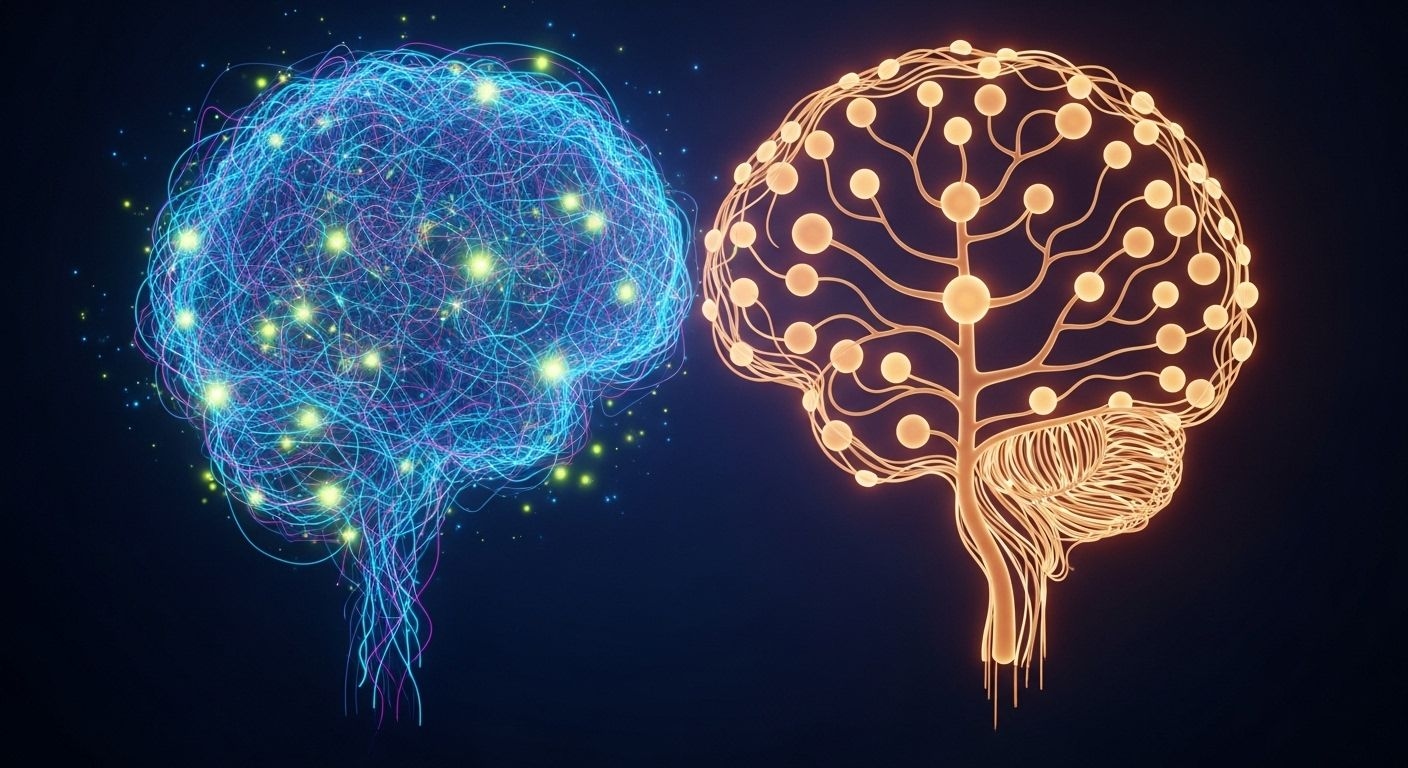


Why Standard AI Fails at Research
You are six weeks into a literature review. You have read 40 papers, formed a working hypothesis, and started to see a pattern in the methodology choices across three subfields. You open a new AI session to think through the pattern. The AI has no idea who you are, what you have been working on, or what the hypothesis was.
You paste context. You re-explain the framework. You get a useful response. You close the tab. Next session, same problem.
This is not an AI problem in the narrow sense. It is an architecture problem. General-purpose chat tools were not designed for the way research actually unfolds: across months, across competing hypotheses, across layers of open questions that are never cleanly resolved. The ai research workflow that most tools assume is linear, session-bound, and disposable. Real research is none of those things.
The Context Window Problem Is Structural
Every AI chat session begins with amnesia. Your working hypothesis, your card-file of sources, your partially confirmed findings, none of it carries over. Even within a single session, long threads push earlier reasoning out of the model's active context window. The AI forgets your hypothesis, not because it is unintelligent, but because the tool was not built to hold evolving knowledge over time.
This is a fundamental mismatch for any serious researcher. A hypothesis lifecycle spans months, not minutes. The literature review that feeds it spans dozens of papers. The system analysis that frames it requires holding three or four analytical layers simultaneously. No single session can contain that, and no tool that resets between sessions can support it.
The Scroll Problem
Most researchers using AI for literature review tasks end up with the same artifact: a long, undifferentiated scroll. Every source, every question, every tangential insight lives in a flat thread that becomes unsearchable the moment it grows past a certain length. The classical "card-file" method - where each source gets its own entry, tagged, cross-referenced, and retrievable - has no equivalent in a standard AI chat interface.
Eighty papers in a scroll is not a literature review. It is a log.
Research and Writing Live in Separate Worlds
When it is time to write, researchers face a reconstruction problem. Six weeks of threads, notes, and AI-assisted synthesis have to be manually harvested, reorganized, and drafted into a manuscript structure. The thinking and the document are two separate artifacts, maintained in two separate places. The transition from research to manuscript costs hours = sometimes days of re-contextualization work that produces no new knowledge.
How Research Actually Works
There is a textbook description of the research process that most working scientists would recognize as accurate, even if they have never read it explicitly.
The Cognition Cycle Is Not Linear
Research operates on a cycle: practice feeds theory, theory returns to practice, and practice generates new questions. The cycle does not terminate. "The completion of cognition is always relative - new problems arise from every solved one." This is not a flaw in the process. It is the mechanism by which knowledge compounds.
The practical consequence is that ai for non-linear thinking is not a nice-to-have for researchers; it is a prerequisite. Any tool that assumes a linear, conclusion-seeking conversation will eventually break down under the weight of genuine inquiry.
The Problem Tree
Research problems have a hierarchy. A scientific direction contains problems. Problems contain topics. Topics generate specific scientific questions. Questions decompose into research tasks. This is not a metaphor — it is a structural description of how inquiry is organized. A researcher working on methodology development for a longitudinal study is operating simultaneously at the level of scientific direction (the field), problem (the gap in the literature), topic (the specific phenomenon), and task (the specific measurement instrument).
Holding these layers without collapsing them into each other is cognitive work. It requires a tool that can represent a nested structure, not just a sequence.
The Hypothesis Lifecycle
A hypothesis must be relevant, testable, and possess explanatory power. Once formulated, it moves through empirical testing, emerges as confirmed, partially confirmed, or rejected, and either becomes the foundation of a theory or loops back for revision. This process unfolds over months.
Facts of experience plus proven hypotheses equal theory. Theory is the highest form of knowledge systematization. But the path from hypothesis to theory is long, iterative, and full of branching, and most AI tools can support only a single step of that path before the context resets.
Open Questions Are Research Capital
Every research stage is preparatory, active research, manuscript, and application, which generates open questions. These are not failures of the session. They are seeds of the next cycle. A researcher who loses track of an open question loses a potential research direction. In the classical process, these would go into a notebook or card file, tagged for future reference. In a scroll-based AI session, they disappear when the tab closes.
The AI Workspace Built for the Research Cycle
Lyrio was built as an ai cognitive workspace - a structured ai workspace that maps to the actual stages and structure of research, not to the structure of a chat product.
Branching Threads for Non-Linear Inquiry
Where a standard AI chat forces all inquiries into a single sequential thread, Lyrio uses threaded ai chat with full branching. A main research thread on methodology can branch into sub-threads on specific instruments, statistical approaches, or precedent studies without losing the parent thread's context. This is the computational equivalent of the problem tree: hierarchy preserved, context maintained, no collapsing.
Each branch carries its context. The parent thread knows the sub-threads exist. Researchers doing system analysis, which requires holding problem statement, system boundaries, and model construction simultaneously, can run parallel threads and synthesize across them.
Persistent Context Across Sessions
Lyrio retains context across sessions. A working hypothesis pinned at week two is still accessible at week ten. The AI is not starting from zero. This is what persistent context ai means in practice: the workspace accumulates knowledge rather than resetting it. Every session builds on previous work. The knowledge compounds.
This is the specific feature that closes the gap between the hypothesis lifecycle and the tool's memory. When a hypothesis is partially confirmed and requires revision, the researcher can return to it with all prior reasoning intact — no re-pasting, no re-explaining.
Pinned Insights and the Card-File Replacement
Lyrio's pinned insights function as a dynamic card file. Key findings, working hypotheses, and open questions can be tagged, saved, and retrieved at any point. The research notes ai layer is searchable and structured - not a scroll. A literature review ai workflow across 60 to 80 papers becomes a mapped system of threads (one per source or source cluster), with pinned findings that surface patterns across the corpus.
This is how the card-file method translates into an ai research tool built for the current decade.
Multi-Model AI for Different Analytical Tasks
Different research tasks require different analytical tools. Empirical analysis, conceptual synthesis, and methodological critique are not the same kind of thinking, and they are not equally well-served by any single model. Lyrio integrates ChatGPT, Gemini, and Grok in one workspace, allowing researchers to route tasks to the model best suited for them without switching platforms or losing context.
Canvas: From Research Thread to Manuscript Draft
The Canvas feature closes the gap between research and writing. When a set of threads has reached sufficient density and when the synthesis is ready, Canvas converts the research workspace into a structured document. Six weeks of threaded inquiry become a first draft without manual reconstruction. The transition from research to manuscript, which costs hours in a standard workflow, collapses into a single action.
This is the thinking to document ai function that the manuscript stage of research requires. The document is not separate from the thinking; it emerges from it.
In Practice
The Multi-Month Hypothesis
A researcher studying institutional trust dynamics formulates a working hypothesis at month one: that trust erosion follows a threshold model rather than a gradient model. She pins the hypothesis in Lyrio, branches into sub-threads for each empirical test: survey data, case analysis, precedent literature, and tracks each thread's status. At month four, the case analysis partially disconfirms the threshold model. She revises the hypothesis, re-pins the updated version, and continues. The prior reasoning is intact. The revision is traceable. The AI that assists with month-four analysis knows what the hypothesis was at month one.
The Literature Review Across 80 Papers
A PhD student conducting a systematic review on urban heat island mitigation creates one thread per paper cluster, pins key findings, and uses Lyrio's search to surface cross-cutting themes. At the synthesis stage, he uses Canvas to generate a structured draft of the literature review section. He does not start with a blank document; he starts with a document that reflects six weeks of organized thinking. The ai to synthesize research function is not a summary button. It is a workspace-to-document pipeline.
The System Analysis
A research analyst building an evaluation framework for a public health intervention runs three parallel threads: one for problem statement and goals, one for system boundaries, and one for model construction. She uses different models for different threads, and one for conceptual precision and another for quantitative framing. Canvas synthesizes across threads into a draft framework document. The analytical layers never collapse into each other. The synthesis is deliberate, not accidental.
If This Is the Workflow You Have Been Looking For
Research is not a conversation. It is a system of nested questions, evolving hypotheses, accumulated evidence, and unresolved threads that compound over months into something that can eventually be called knowledge.
The tools most researchers use for AI assistance were not designed for this. They were designed for conversations: single sessions, single threads, single tasks.
Lyrio is designed for the research cycle. Threaded, persistent, structured, and built to carry working knowledge from the first hypothesis to the final manuscript.
If you are a researcher, analyst, or PhD student who spends time re-explaining your context at the start of every session or sees your open questions disappear when you close the tab, Lyrio is worth a serious look.